Key Takeaways
Finding the right CNA program takes more than choosing the nearest search result. Compare approval, schedule, total cost, clinical training, and career support before you enroll.
- Search by location, then verify the exact campus and service area.
- Confirm state approval, training hours, prerequisites, and exam eligibility.
- Compare the full cost, including supplies, screenings, testing, and travel.
- Ask about clinical placements, class size, instructors, and job support.
- Gather documents early so enrollment does not delay your start date.
Start your search for local CNA classes
When you search for “cna classes close to me,” distance is a useful starting point, but it should not be your only filter. A nearby program may have a schedule that conflicts with work, limited clinical availability, or requirements you did not expect. Begin with a broad list, then narrow it using details you can verify directly.
A directory such as CNA Classes USA can help you identify programs by location before you contact individual schools. Treat the first results as leads rather than final recommendations. The strongest choice is usually the program that fits your life and clearly explains how it prepares students for certification.
Use search engines, maps, and local directories
Search engines and map apps can reveal schools, adult education centers, and training providers that are easy to miss. Try several versions of your search, including the name of your city, nearby ZIP codes, and terms such as “nurse aide program” or “state-approved CNA training.” Save the program name, address, phone number, next start date, and website for each promising result.
A short comparison list keeps the search from becoming repetitive. Record these details while they are easy to find:
- Exact class location and estimated travel time
- Upcoming start dates and application deadlines
- State approval information and program contact person
- Published tuition and additional required fees
Afterward, call or email to confirm that the listing is current. A map pin alone does not tell you whether the location is a permanent campus, a temporary classroom, or an office that does not host classes.
Check community colleges and vocational schools
Community colleges, technical colleges, and vocational schools often publish more complete program information than general search listings. Review the course catalog for admission rules, required hours, clinical expectations, grading policies, and the credential awarded at completion. Also check whether the program runs every term or only a few times each year.
Ask whether the school has an admissions advisor who can explain the sequence from application to certification. The CNA Classes USA blog can offer general guidance while you build questions, but the school remains the source for its own dates, policies, and costs. Comparing two or three catalogs side by side can make meaningful differences visible.
Explore hospitals, nursing homes, and workforce programs
Hospitals, nursing homes, and public workforce agencies may offer training connected to local hiring needs. Some programs are sponsored or subsidized, while others require a work commitment after graduation, so read the terms carefully. Ask who teaches the course, where clinical practice occurs, and whether the program leads to eligibility for your state’s certification examination.
Employer-based training can be appealing when it reduces upfront cost, but it may limit your flexibility. A workforce program may also have income, residency, or unemployment requirements. Do not assume that a free class has no obligations; request the details in writing before accepting a place.
Verify each program’s service area and class location
A school may advertise broadly across a county or metropolitan area while holding classes at only one campus. Confirm the street address, parking or transit options, and whether classroom, laboratory, and clinical sessions happen at different sites. This matters especially when the advertised program is “near” you but the clinical facility is much farther away.
Use the program’s official contact information to check whether remote students can apply and whether out-of-area applicants face different rules. This simple step can prevent a costly surprise after you have paid an application fee or arranged time away from work.
Compare CNA program approval and requirements
CNA education is regulated at the state level, so requirements vary by location. Before comparing tuition or convenience, make sure each program can provide a clear path to the credential you want. Approval status, training hours, admission rules, and examination eligibility should be easy to confirm.
Keep copies of program pages, emails, and enrollment documents as you compare schools. If a representative gives you a verbal answer about eligibility or fees, ask for a written confirmation. That record can help resolve confusion later.

Confirm state approval and accreditation
Look for the state agency or nurse aide registry that recognizes the program. “Accredited,” “approved,” and “licensed” can have different meanings, so ask which organization grants the status and whether it applies to the specific course you plan to take. A school should also explain what happens if approval changes before your class finishes.
Do not rely on an old brochure or a third-party listing. Verify the current status through the relevant state source or obtain the approval information directly from the school. This is one of the most consequential checks because an inexpensive course is not useful if it does not meet your state’s training rules.
Review admission requirements and prerequisites
Programs may require identification, a minimum education level, an entrance assessment, immunization records, or proof of legal eligibility to work. Some also require a physical examination, drug screening, CPR training, or a background check before clinical attendance. Ask for the complete checklist rather than assuming that the application page includes everything.
Clarify which items are needed to apply and which can be submitted after acceptance. Find out whether missing paperwork moves you to a later cohort. Knowing the order of requirements lets you plan appointments and avoid losing a seat over a document that takes several weeks to obtain.
Check classroom, laboratory, and clinical training hours
A quality comparison separates classroom instruction from laboratory practice and supervised clinical training. Ask how many hours are assigned to each setting, where clinicals take place, and whether attendance is mandatory for every component. A course that looks short may simply place more requirements outside the advertised classroom schedule.
Write the answers into a simple comparison table. It makes vague descriptions easier to test and gives you a useful record when speaking with admissions staff.
| Program detail | School A | School B | School C |
|---|---|---|---|
| Classroom hours | Confirm | Confirm | Confirm |
| Laboratory hours | Confirm | Confirm | Confirm |
| Clinical hours and site | Confirm | Confirm | Confirm |
| Make-up policy | Confirm | Confirm | Confirm |
The table is not a substitute for official documentation, but it highlights the questions that deserve a direct answer. Pay special attention to clinical make-up rules because missed hours can affect graduation timing.
Understand certification exam eligibility
Ask exactly which exam graduates may take, how the school submits completion information, and whether students must apply separately to the state. Some programs include test preparation but not the examination fee. Others may require students to complete additional paperwork before an application can be processed.
The structure of the exam can also affect how you study. Confirm whether your state uses a written or oral portion, a skills demonstration, or another format. Do not enroll until you understand what completion of the course does—and does not—guarantee.
Evaluate schedules, formats, and learning options
The most convenient CNA course is one you can attend consistently. Compare the weekly timetable, required campus visits, clinical shifts, and expected study time rather than looking only at the advertised course length. A program that fits your responsibilities is more valuable than one that is technically closer but difficult to complete.
Ask for a sample weekly schedule before you pay. Schedule changes, holiday policies, and clinical assignments can influence childcare, transportation, and work arrangements.
Compare weekday, evening, and weekend classes
Morning, evening, and weekend cohorts serve different needs, but the labels may not tell the whole story. An evening class can still require daytime clinical shifts, and a weekend program may include weekday testing or orientation. Request the schedule for the entire course, including skills practice and clinical placement.
Also ask how often absences are permitted and whether missed sessions can be made up. Consistent attendance is easier when you know the rules in advance and have a backup plan for work or family obligations.
Decide whether online coursework fits your needs
Online coursework may offer flexibility for reading, quizzes, and other academic tasks, but CNA education still requires hands-on learning and supervised practice. Find out which activities are online, which must happen in person, and whether students need reliable internet, a webcam, or specific software.
Consider your learning style as well. If you learn best by watching a procedure and practicing it repeatedly with immediate feedback, an entirely self-paced academic component may require extra discipline. Ask how quickly instructors respond to questions and how practical skills are evaluated.
Review clinical placement arrangements
Clinical placement is more than a line in the brochure. Ask whether the school arranges the site, how far students may travel, and when placements are assigned. You should also learn whether a delayed placement can postpone completion or examination paperwork.
Confirm the required clothing, equipment, transportation, and conduct rules for clinical days. If the school uses several facilities, ask whether students can request a preferred site or shift. Clear answers help you estimate the real weekly commitment.
Ask about class size and instructor support
Class size affects how much time you receive to practice essential skills. Ask how many students share equipment, how instructors provide corrections, and whether tutoring or review sessions are available before testing. Experienced instructors are helpful, but their availability between class meetings matters too.
A useful conversation includes questions about communication. Find out whether support is handled by email, a learning platform, office hours, or scheduled appointments. You are evaluating the support system, not just the personality of the instructor you happen to meet.
Calculate the total cost of CNA training
Tuition is only one part of the budget. Application fees, uniforms, books, screenings, examination charges, transportation, and lost work hours can change the final amount substantially. Request an itemized estimate and ask which expenses are paid to the school and which are paid to outside providers.
Prices should be compared alongside what is included. One course may provide equipment and practice materials, while another advertises a lower tuition but leaves those purchases to the student.
Compare tuition and registration fees
Start with the published tuition, registration charge, deposit, payment schedule, and refund policy. Ask whether the quoted price applies to the full program or only the classroom portion. If payment plans are available, confirm the due dates and whether there is an additional finance or administrative charge.
A low deposit can make a course look accessible, but the remaining balance may be due before clinical training begins. Get the complete payment calendar so you can compare programs fairly.
Include textbooks, uniforms, supplies, and background checks
Make a checklist of every item required before the first clinical day. Costs vary by program and location, so use the school’s current list instead of a general estimate. The same caution applies to screenings, which may involve separate vendors and appointment fees.
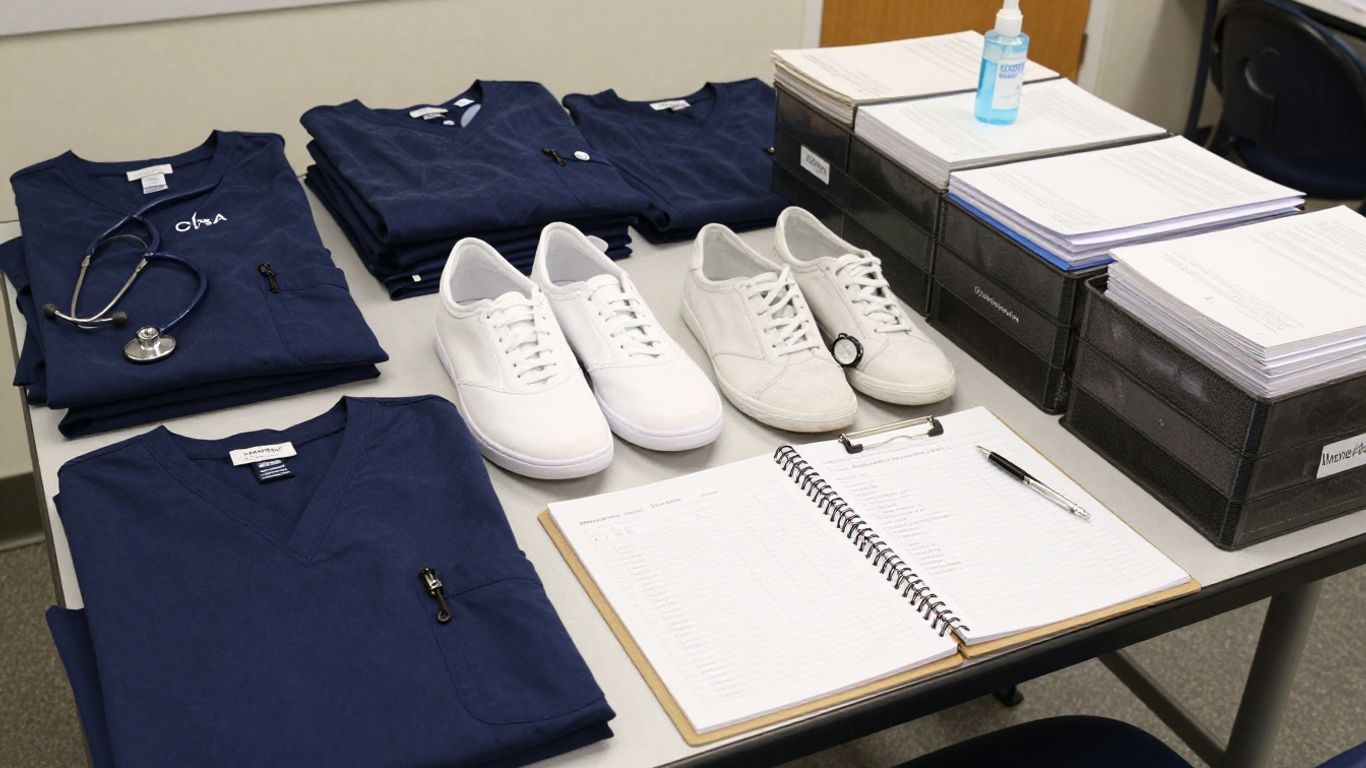
It helps to group one-time purchases separately from recurring expenses. Uniforms, shoes, a watch, books, and basic clinical supplies may be manageable individually but significant when purchased all at once. Planning them early gives you more options for finding permitted, reasonably priced items.
Budget for exams, certifications, and transportation
Ask whether certification testing, CPR training, fingerprinting, drug screening, and registry applications are included. Then estimate travel to campus, laboratory sessions, clinical sites, and testing locations. Public transit time, parking, fuel, and occasional rideshare costs all belong in the calculation.
A realistic budget should also include the cost of taking unpaid time off. If a class has mandatory weekday clinicals, that schedule may affect your income even when tuition is affordable.
Look for grants, scholarships, and employer-paid training
Check with the school, workforce agency, employer, union, and local community organizations for assistance. Ask whether aid is restricted to tuition or can cover books, uniforms, transportation, and testing. Some awards have application deadlines well before the class begins.
Employer-paid training can involve retention requirements or repayment clauses. Read those terms carefully and keep a copy. Financial help is most useful when you understand both the immediate savings and the commitments attached to it.
Assess each school’s career preparation
A CNA program should prepare you for the transition from student to entry-level healthcare worker. Career preparation may include employer introductions, application guidance, interview practice, or clear information about local hiring expectations. Ask what is actually included rather than assuming a school’s employment claims cover every graduate.
For broader planning, CNA Classes USA publishes information about program selection and career development. Use general guidance to frame your questions, then evaluate each school using its own documented outcomes and services. The goal is a realistic picture of what happens after completion.
Review job placement and employer partnerships
Ask whether the program tracks employment, hosts hiring events, or maintains relationships with nearby healthcare facilities. Find out if interviews are guaranteed, merely available, or not part of the course at all. A partnership can create an introduction, but it does not replace meeting the employer’s hiring requirements.
You can also ask recent graduates where they found work and how long the search took. Schools may share this information in aggregate, but request the date range and definition of “placement” so you know what the number means.
Ask whether resume and interview support is included
A first healthcare resume may need to highlight clinical practice, communication, safety awareness, and relevant experience rather than a long employment history. Ask whether an instructor or career advisor reviews resumes and conducts mock interviews. Find out whether these services are included in tuition or offered separately.
It is reasonable to request a sample of the support materials before enrolling. Practical help with applications can be especially valuable if you are changing careers or returning to work after a gap.
Examine pass rates and student outcomes
Request recent certification examination pass rates, completion rates, and withdrawal rates. Ask how many graduating students were included and which testing period the figures cover. A single impressive percentage says little without a denominator and a time frame.
Look for patterns across several cohorts. If a school will not share basic outcome information, treat that lack of transparency as a reason to investigate further rather than as proof of poor instruction.
Consider pathways to nursing school or advanced certifications
CNA work can provide useful patient-care experience, but it does not automatically transfer as college credit or guarantee admission to nursing school. Ask whether the school has advising relationships with colleges, bridge information, or guidance about prerequisites. Confirm any transfer policy with the receiving institution.
You may also want to explore later certifications, such as medication aide or patient care roles, depending on your state and career goals. Choose a CNA program that supports your next step without making promises it cannot control.
Complete the enrollment process
Once you have compared programs, enrollment becomes a project with several moving parts. Keep a folder—digital or paper—for forms, receipts, health records, and messages from the school. Read every deadline twice, especially when a program has limited seats or a cohort begins soon.
CNA Classes USA can help you return to local program searches if your first choice is full or the schedule changes. Before submitting payment, confirm the class location, start date, cancellation policy, and complete list of required documents one more time.
Gather identification, education, and health records
Prepare the identification, education records, immunization documentation, physical forms, and other materials listed by the program. Ask whether copies are accepted, whether documents must be current, and whether a healthcare provider must complete specific forms. Missing one item can delay clinical clearance.
Use the school’s checklist as your source of truth. Requirements differ by state and institution, so a document accepted by one program may not satisfy another.
Complete background checks and required screenings
Background checks, fingerprinting, drug screens, and physical examinations often have expiration periods or approved-provider rules. Ask when each screening must be completed and how results are sent to the school. Do not schedule an appointment with an unapproved vendor until admissions confirms it will be accepted.
If a record may require review, ask about the process early and answer forms accurately. A delay does not necessarily end your application, but waiting until orientation can leave too little time for resolution.
Register for the certification examination
Find out whether the school registers students as a group or expects each student to apply independently. Confirm the application deadline, testing fee, identification rules, and process for selecting a testing date. Keep your confirmation number and all correspondence.
If your state requires the school to verify completion first, ask when that verification is sent. Understanding the sequence prevents you from assuming that finishing class automatically schedules the exam.
Prepare for orientation and the first day of class
Orientation may cover attendance, dress code, technology, clinical conduct, safety, and required supplies. Read the materials before arriving and plan the route to every required site. Pack only the equipment listed by the school, since clinical settings often have specific rules.
Finally, contact the program if your circumstances change before the start date. A timely conversation about work, transportation, or health documentation is far easier to manage than an unexplained absence during the first week.
Conclusion
The best CNA program is not simply the one that appears first when you search nearby. Compare approval, hands-on hours, schedule, complete cost, student support, and career preparation, then enroll only after the requirements and next steps are clear. A careful search now can make training more manageable and your path to certification more predictable.
Frequently Asked Questions
How do I find cna classes close to me?
Search by city, ZIP code, and nearby communities using maps, school websites, workforce agencies, and CNA directories. Then verify the program’s current address, start date, approval status, and clinical location directly with the provider.
How long does CNA training usually take?
The length varies by state and school. Compare the separate classroom, laboratory, and clinical hours, because an advertised course length may not include every required activity or may use an intensive schedule.
Can I complete CNA training online?
Some academic coursework may be online, but CNA programs generally require in-person skills practice and supervised clinical experience. Ask exactly which portions are remote and how often you must attend campus or a clinical site.
What should I ask a CNA school before enrolling?
Ask about state approval, admission requirements, total cost, attendance rules, clinical placements, exam eligibility, class size, instructor support, and recent student outcomes. Request important answers in writing.
What costs should I budget beyond tuition?
Plan for registration, books, uniforms, shoes, supplies, background checks, health screenings, CPR training, certification testing, transportation, parking, and possible unpaid time away from work.
Do CNA programs help with job placement?
Some schools offer employer introductions, hiring events, resume reviews, or interview practice. Ask how the service works, whether it is included, and how the school defines and measures job placement.
What documents are commonly needed for enrollment?
Programs may request identification, education records, immunization documentation, physical examination forms, screening results, and background-check information. The exact list depends on your state and the individual school.