Key Takeaways
Choosing a CNA training program is easier when you compare approval, hands-on practice, scheduling, total cost, and career support together.
- Confirm that the program is approved by the appropriate state agency.
- Look for meaningful lab practice and supervised clinical experience.
- Calculate fees beyond tuition, including supplies, screenings, and exams.
- Choose a schedule that fits your work, family, and transportation needs.
- Ask how the program prepares students for certification and employment.
Understand what a CNA training program includes
A CNA training program should prepare you for both the practical work of patient care and the competency exam required in your state. Most programs combine classroom learning, skills practice, and supervised clinical experience, although the hours and sequence vary. Before enrolling, compare the actual curriculum with your state’s requirements rather than relying on a short course description.
The CNA program comparison guide is useful as a starting point because it focuses on approval, training hours, clinical access, cost, and career support. Those same categories will help you distinguish a serious program from one that simply promises a quick certificate.
Classroom instruction and core nursing concepts
Classroom lessons generally introduce communication, infection prevention, safety, residents’ rights, vital signs, nutrition, mobility, and assistance with daily living. You should also learn how a nursing assistant works under the direction of licensed nursing professionals and how to report changes in a patient’s condition. Strong instruction connects each concept to a situation you may encounter during a shift.
Ask whether lessons include demonstrations, discussion, and opportunities to ask questions. A course that moves rapidly through slides without checking understanding may leave you underprepared when you begin practicing skills.
Hands-on lab practice and clinical experience
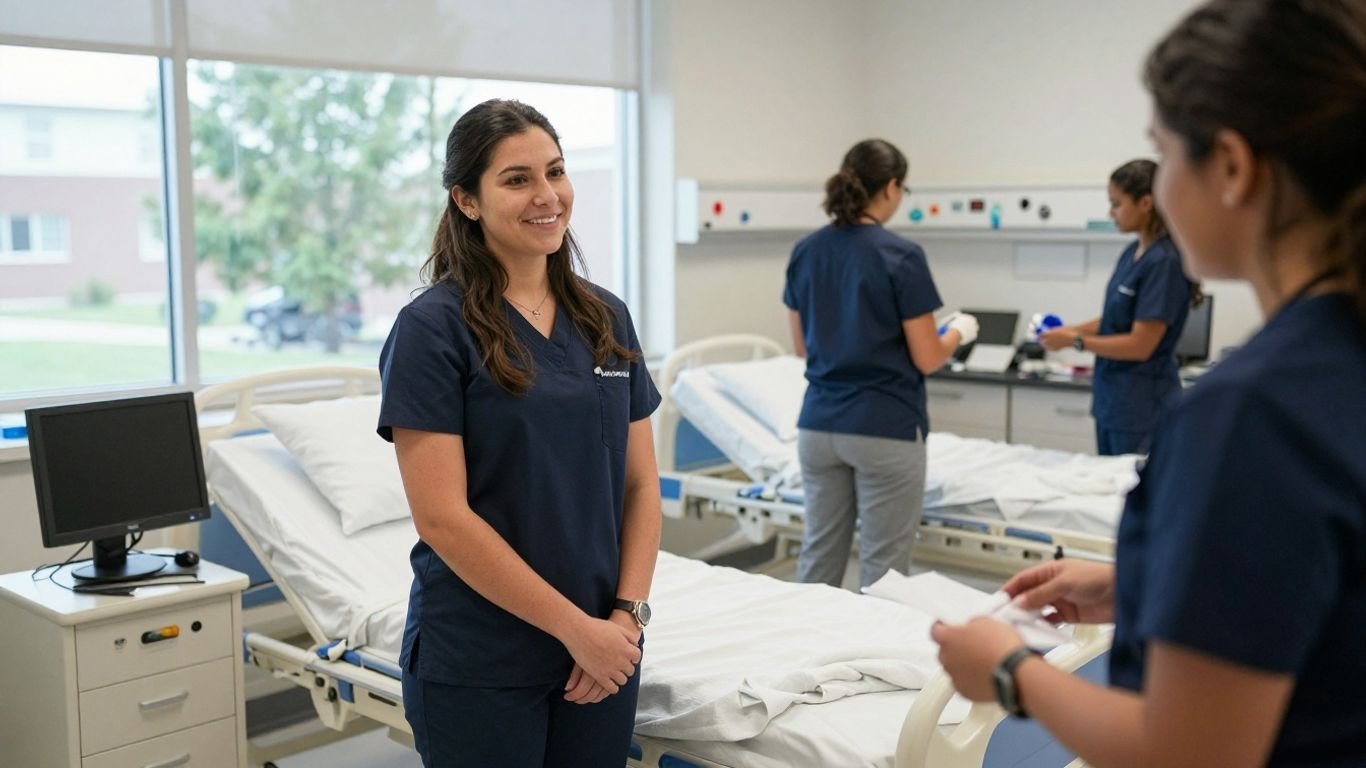
Lab sessions let you practice tasks in a controlled setting before working with patients. Depending on the curriculum, that may include hand hygiene, transferring, positioning, making beds, measuring vital signs, assisting with personal care, and using appropriate communication. Clinical experience then gives you a supervised opportunity to apply those skills in a real care environment.
The distinction matters: watching an instructor perform a task is not the same as performing it yourself. Ask how many students share each practice station, how instructors correct mistakes, and where clinical rotations take place. The Nurse Aide Training Program offered by Kapi’olani Community College, for example, is described as combining lecture, lab, and clinical experience in a state-approved course; use that structure as a useful comparison point, not as a universal requirement.
State-approved curriculum requirements
Approval is the gatekeeping issue because each state sets its own eligibility, training, examination, and registry rules. A program may advertise accreditation or career training, but that does not automatically mean it satisfies the nurse aide requirements in your state. Verify the school and the specific course with the state nursing board or other designated agency.
Training hours, clinical hours, health documents, and renewal procedures can change by jurisdiction. If you are comparing locations, read a state-specific guide such as the one covering CNA certification in Illinois, then confirm current details with the relevant state authority.
Skills covered on the certification exam
Most state competency exams include a knowledge component and a hands-on skills component, though the exact structure and tested tasks differ. Your program should explain how it maps lessons and practice sessions to the exam blueprint. It should also tell you who schedules the test, what documents you need, and which fees are separate from tuition.
A good course does not teach only to a checklist. It helps you understand why safety, privacy, infection control, dignity, and accurate reporting matter in every skill. That foundation is useful long after test day.
Compare program formats and schedules
The best format is the one you can attend consistently and complete successfully. A short course is not necessarily easier, while a longer course is not automatically better. Compare the number of instructional hours, the amount of in-person practice, the clinical schedule, and the travel involved before choosing based on calendar length alone.
Programs may be offered by colleges, career schools, community organizations, or healthcare employers. The guide to CNA classes and certification provides broader background on common program timelines and the path from training to certification, but your own state and school remain the final sources for requirements.

Full-time, part-time, and accelerated options
Full-time classes can help you finish sooner and build momentum, but they may require daytime availability and a temporary reduction in work hours. Part-time courses spread the workload across more weeks, which can be more manageable for caregivers or people with regular jobs. Accelerated programs demand concentrated study and quick skill development, so ask how much independent work is expected between sessions.
Do not compare “four weeks” with “twelve weeks” until you know what those labels include. A short course may still require clinical days, testing appointments, and preparation outside scheduled class time.
In-person, hybrid, and online coursework
Online lessons can make reading and lecture material easier to fit around other commitments. However, core physical skills require demonstration, repetition, feedback, and usually in-person lab or clinical time. Hybrid programs can work well when their in-person schedule is clearly published and the school explains how online attendance is recorded.
Before paying a deposit, ask whether online modules are live or self-paced, how instructors answer questions, and where you will complete hands-on requirements. A program that cannot give you a precise answer about lab and clinical arrangements deserves careful scrutiny.
Evening and weekend class availability
Evening and weekend schedules can make training possible for people working days or caring for children. Check whether the entire course follows that schedule or whether clinical rotations occur during weekday hours. Also confirm the start and end times, attendance policy, makeup process, and holiday calendar.
Transportation deserves attention too. A class that looks convenient on paper may become difficult if the lab is in one location and the clinical site is far away. Build a realistic travel plan before enrolling.
Balancing training with work or family responsibilities
A CNA course involves more than time spent sitting in class. Plan for reading, practice, commuting, document collection, and exam preparation. If your schedule is already full, select a pace that leaves room for sleep and revision rather than assuming you can make up every missed hour.
Write down your weekly commitments and mark the hours available for training. Then ask the school to identify every mandatory activity. A realistic schedule protects completion better than an ambitious plan that collapses after the first demanding week.
Evaluate program quality and approval
Program quality is visible in the details: instructors who can explain skills clearly, equipment that resembles a care setting, timely answers to student questions, and clinical experiences that are properly supervised. Marketing language can sound impressive, but specific policies and outcomes tell you more. Treat a school visit or information session as a fact-finding opportunity.
You can also compare several programs using the same questions. Consistency makes differences in approval, support, cost, and preparation easier to see.
Checking state nursing board approval
Start with the state agency responsible for nurse aide training and certification. Confirm that the school’s name, course name, and location match the approved listing, especially if the provider operates at multiple sites. Ask whether approval covers the current version of the course and whether graduates are eligible to sit for the state exam.
Approval should be confirmed before you submit money or personal documents. For a more detailed example of how state requirements can differ, review the state-approved CNA training overview and then verify the current rules locally.
Reviewing instructor credentials and student support
Ask who teaches lecture, lab, and clinical portions of the course. Instructors should have relevant nursing or nurse aide experience and a clear understanding of the state exam. You should also know how students receive feedback, what happens when a skill needs repeated practice, and whether tutoring or review sessions are available.
Student support includes administration, not just teaching. Find out who handles attendance records, exam applications, schedule changes, disability accommodations, and questions about health documentation. Responsive support can prevent a small paperwork issue from delaying certification.
Comparing graduation and exam pass rates
Completion and pass-rate data are useful when the school defines what the numbers mean. Ask for the time period, number of students, first-attempt pass rate, and whether the figures include every enrollee or only graduates who tested. A single percentage without context is not enough to judge quality.
Look for patterns rather than a promotional high point. If a program will not share basic outcome information, ask why and weigh that silence alongside other evidence such as instructor access, lab time, and student reviews.
Identifying clinical placement partnerships
Clinical placement should be more than a promise that students will eventually visit a facility. Ask where rotations occur, how placements are assigned, how many students attend at once, and whether the school or student is responsible for transportation. You should also learn what happens if a facility cancels or a required health document is delayed.
A dependable partnership gives students exposure to real routines while preserving supervision and patient privacy. It can also help you understand which work settings feel like a good fit before you begin applying for jobs.
Calculate the total cost of training
Tuition is only one part of the price of becoming a CNA. Registration, books, uniforms, transportation, screenings, exam fees, and missed work can all affect your budget. Request a written cost sheet and ask which charges are paid to the school, a testing vendor, or another agency.
A simple comparison table can prevent an apparently inexpensive program from becoming the more expensive choice after enrollment.
Tuition, registration fees, and course materials
Ask whether tuition includes lab use, online access, textbooks, workbooks, practice tests, and exam preparation. Some schools charge a separate registration or technology fee, while others bundle those items into one price. Also ask when each payment is due and whether a deposit is refundable.
Record the total in one place rather than comparing tuition figures alone. If a provider advertises an unusually low price, request a complete list of required purchases before deciding.
| Cost category | What to ask | Why it matters |
|---|---|---|
| Tuition and registration | What is included and when is payment due? | Reveals the basic enrollment commitment |
| Materials and uniform | Are books, shoes, scrubs, and supplies separate? | Shows likely out-of-pocket course costs |
| Screening and health items | Who pays for checks, tests, and immunizations? | Clinical eligibility may add unexpected fees |
| Certification and registry | Which exam and application charges are excluded? | Prevents last-minute testing surprises |
| Transportation and time | How far are class and clinical sites? | Captures practical costs beyond the invoice |
After filling in these categories, compare the total rather than the advertised tuition. A payment plan may still be worthwhile if it covers more required items and gives you reliable access to practice.
Uniforms, supplies, background checks, and immunizations
Clinical participation often requires specific clothing, closed-toe shoes, identification, and basic supplies. Programs may also require a criminal background check, drug screening, CPR or first aid documentation, physical clearance, tuberculosis testing, or immunization records. Requirements differ, so ask for the exact list and deadlines.
Do not assume an old health record will satisfy a new clinical site. Budget for appointments, copies, transportation, and possible repeat tests if documentation is incomplete.
Certification exam and licensing expenses
Many states charge separately for the knowledge exam, skills exam, application, registry, or fingerprinting. Some programs collect those fees; others expect students to register independently. Ask whether the tuition includes one attempt and what happens if you need to retest.
Clarify whether “certification” and “licensing” are being used accurately in your state. The terminology and process may vary, and the state agency’s instructions should control your planning.
Grants, scholarships, payment plans, and employer assistance
Financial help may come from a school, workforce agency, employer, nonprofit, or local education program. Ask whether assistance is awarded before enrollment, whether it covers supplies and exams, and whether it creates a work commitment. Employer-sponsored training can be helpful, but read repayment or employment terms carefully.
When contacting organizations online, use caution with personal information. For example, a privacy policy can show how a website describes cookies and submitted data, but it does not replace checking the school’s enrollment and financial-aid terms directly.
Prepare for admission and enrollment
Admission requirements vary by state and provider, so gather information before choosing a start date. Many schools ask for identification, proof of education or age, health records, and background information. Some also use an interview or basic skills assessment to determine readiness.
Make a checklist from the school’s written instructions and keep copies of everything you submit. This is especially useful when clinical placement has a separate deadline from classroom enrollment.
Common education and age requirements
Some programs require a minimum age, a high school diploma or equivalent, reading proficiency, or proof of legal identity. Others may accept applicants without a diploma but use an entrance assessment instead. Do not rely on assumptions based on another state or another school.
Ask whether the requirement applies at application, at the start of class, or before clinical placement. A small timing difference can affect whether you qualify for the next cohort.
Background checks and health documentation
Background checks and health records are common because students work around vulnerable people. Requirements may include a criminal history check, drug screen, physical exam, immunizations, CPR certification, or liability coverage. A record that needs review is not always an automatic rejection, but the school should explain its process before you pay.
Ask who receives sensitive documents, how long processing takes, and whether an issue can delay clinical participation. Keep a personal file with dates, receipts, and confirmation emails.
Entrance assessments and prerequisite courses
An entrance assessment may test reading, mathematics, language, or basic computer skills. Prerequisites can include CPR, first aid, orientation, or a short healthcare readiness course. Find out whether these are included in the advertised program length.
If you need preparation, ask whether the school offers a refresher or recommends a specific resource. Completing a prerequisite early can make the first weeks of the CNA course less stressful.
Questions to ask before applying
A short conversation with an admissions adviser can reveal more than a polished webpage. Bring specific questions and request written answers when the response affects cost, eligibility, or exam access. Useful questions include:
- Is this exact course approved by the state agency?
- How many hours are classroom, lab, and clinical hours?
- What costs are not included in tuition?
- Who teaches and supervises each part of the program?
- What support is available if I miss a day or need more practice?
The answers should be clear, consistent, and easy to verify. If an adviser avoids basic questions, keep comparing programs before making a commitment.
Get ready for the CNA certification exam
Exam preparation should begin during training rather than in the final few days. Review the state handbook, understand the testing format, and use practice to identify weak areas. Your goal is accurate, safe performance—not simply memorizing a sequence of words.
Keep exam registration separate from course completion in your calendar. Finishing class may make you eligible, but you may still need to submit an application, schedule a date, and bring approved identification.
Written or knowledge test preparation
For the knowledge test, review vocabulary, infection control, safety, communication, residents’ rights, basic care, and observation and reporting. Read each question carefully and distinguish the safest first action from a later intervention. Practice questions are most useful when you review why an answer is correct.
Use the state’s candidate handbook as your primary reference. Commercial study materials can supplement it, but they should not override official instructions or current exam content.
Clinical skills test practice
Skills testing rewards preparation, organization, and calm communication. Practice setting up supplies, explaining the procedure, protecting privacy, washing hands, maintaining safety, and reporting completion. Say important steps aloud when the testing format expects verbalized actions, and learn which errors cause an automatic failure.
Ask an instructor to watch you from start to finish without interrupting unless safety requires it. That kind of rehearsal can reveal forgotten details that feel obvious when you practice alone.
Creating a study plan and using practice tests
Divide your study time into short, repeatable sessions. Review one topic, perform or describe the related skill, and then answer practice questions without looking at your notes. Keep a record of missed questions so that each session addresses a real weakness.
A practical plan might include these stages:
- Read the official candidate handbook and mark unfamiliar terms.
- Review classroom topics in small groups rather than one long sitting.
- Practice each required skill using the correct order and safety steps.
- Complete timed practice tests and review every missed answer.
- Rehearse the trip, identification, arrival time, and required supplies.
After each session, write down what improved and what still feels uncertain. That simple record keeps preparation focused and makes the final week less frantic.
What to do after an unsuccessful attempt
An unsuccessful attempt is information about what to change, not a final judgment about your ability to provide care. Read the score report or testing feedback, check the retest rules, and contact your instructor about targeted practice. You may need to repeat the knowledge test, the skills test, or both, depending on state policy.
Before scheduling again, identify the exact weak areas and create a new practice plan. Also confirm deadlines, fees, required documents, and the number of attempts allowed.
Plan your first steps after certification
Certification opens the door, but your first job search still requires preparation. Think about the setting, shift, commute, patient population, and supervision you want while building confidence. Entry-level work can provide valuable experience, even when the first position is not your long-term destination.
Use your training records, clinical feedback, and references to describe what you can do honestly. Never claim independent responsibilities outside the CNA scope in your state.
Building a CNA resume with limited experience
A new resume can highlight clinical hours, lab competencies, relevant coursework, CPR or first aid credentials, and qualities demonstrated through work or volunteering. Describe tasks clearly without overstating your authority. For example, mention assisting with activities of daily living, observing changes, maintaining privacy, and reporting concerns when those activities were part of your training.
Include availability, transportation, languages, and technology skills when relevant. A concise resume paired with a thoughtful cover note can make limited paid experience less of a barrier.
Finding jobs in hospitals, nursing homes, and home care
CNAs may find opportunities in nursing homes, assisted living communities, hospitals, rehabilitation settings, and home care, depending on state rules and employer requirements. Each setting has a different pace and level of independence. Read the job description closely and ask how orientation, supervision, scheduling, and patient assignments work.
Use clinical contacts, school career services, local job boards, and direct applications. The goal is not merely to get an offer; it is to find a role where you can learn safe routines and receive useful feedback.
Comparing wages, benefits, and work settings
Pay is only one part of a job offer. Compare shift differentials, overtime rules, health coverage, paid time off, retirement benefits, transportation, staffing, orientation, and opportunities for additional training. A slightly higher hourly rate may not compensate for a long commute or unpredictable schedule.
During an interview, ask about typical assignments, lifting expectations, breaks, weekend rotation, and how the facility handles call-outs. These answers can give you a clearer picture of daily work than the job title alone.
Using CNA experience to pursue further nursing education
CNA work can help you develop communication, observation, teamwork, time management, and comfort around patients. If you plan to pursue practical nursing or registered nursing education, review prerequisites and admission requirements early. Some schools may recognize healthcare experience, but you should not assume that CNA training automatically transfers for academic credit.
Keep copies of your certificate, exam results, immunization records, CPR documentation, and employment evaluations. A well-organized file makes future applications easier and helps you explain how your first role shaped your next career decision.
Conclusion
The right CNA training program gives you a credible path from foundational lessons to supervised practice, certification, and a first healthcare role. Compare approval, instruction, clinical access, schedule, total cost, and student support with the same care you would use to evaluate any major commitment. Once the details fit your life and your state’s requirements, you can begin training with a clearer plan and a stronger foundation.
Frequently Asked Questions
How long does a CNA training program take?
Program length varies by state, school, and schedule. Accelerated courses may finish in a few weeks, while part-time programs can take several months; always compare required hours rather than the calendar label alone.
Is online CNA training enough to become certified?
Online coursework may cover lecture material, but nursing assistant skills generally require in-person practice and supervised clinical experience. Confirm that any hybrid format meets your state’s requirements before enrolling.
What should I look for in an approved CNA program?
Verify state approval, required classroom and clinical hours, instructor qualifications, lab access, exam preparation, transparent costs, and a clear process for clinical placement.
Do CNA programs require a high school diploma?
Requirements differ. Some programs require a diploma or equivalent, while others use an entrance assessment or set a minimum age; check both the school and the state agency.
What costs should I budget besides tuition?
Plan for registration, books, uniforms, shoes, supplies, background checks, health screenings, immunizations, transportation, certification exams, and possible retesting fees.
What happens if I fail the certification exam?
Review the official score information, identify the weak section, check retesting rules and deadlines, and create a targeted practice plan with help from your instructor if available.
Can CNA experience lead to nursing school?
CNA work can build useful patient-care and communication experience for future nursing study. However, each nursing program sets its own prerequisites, admission standards, and policies on transfer credit.