Key Takeaways
Four-week CNA programs can be a practical route into entry-level healthcare work, but the pace leaves little room for missed classes or delayed studying.
- Training usually combines classroom lessons, skills practice, and supervised clinical experience.
- State approval and exam eligibility matter more than a program’s advertised speed.
- Students should confirm all health, background, education, and documentation requirements early.
- Daily review and repeated skills practice are essential in an accelerated format.
- Certification opens several entry-level care settings and can support further healthcare education.
How four-week CNA classes work
Four-week CNA classes compress the usual sequence of theory, practice, and clinical preparation into a concentrated schedule. The exact hours and delivery format vary by state and school, so the calendar alone does not tell you whether a course is sufficient. Before enrolling, compare the curriculum with your state’s requirements and review this guide to four-week CNA classes for a broader look at schedules, costs, and certification preparation.
Typical classroom and clinical training structure
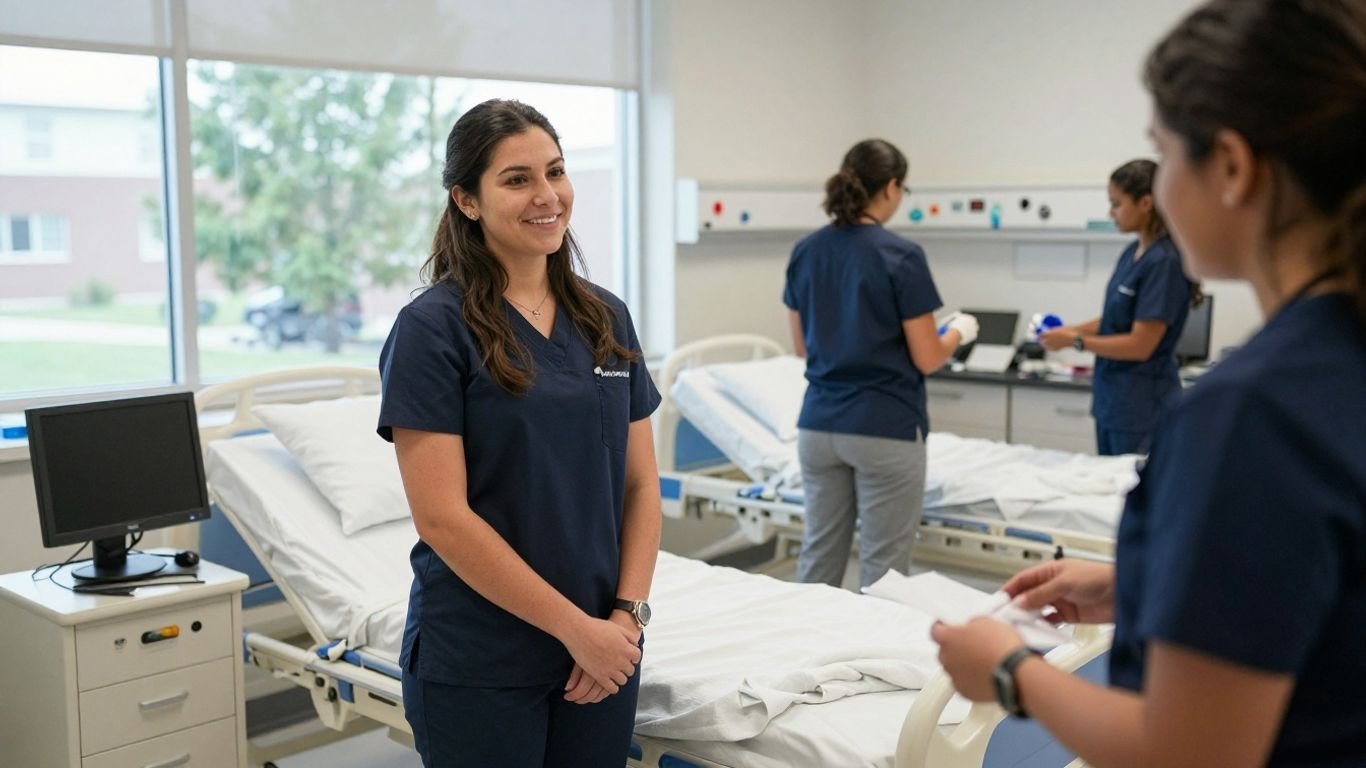
Most programs begin with classroom instruction covering basic nursing concepts, safety, communication, and the role of the nursing assistant. Students then practice procedures in a lab before moving into supervised clinical work, where they apply those procedures with real patients or residents under appropriate oversight. The transition can feel quick, but each stage matters: memorizing a sequence is different from performing it calmly and respectfully.
A well-organized course makes the relationship between theory and practice clear. A lesson on infection control, for example, should lead naturally into hand hygiene, glove use, clean equipment, and safe disposal during skills practice.
How accelerated programs differ from traditional courses
A traditional course may spread similar material across several weeks or months, while an accelerated program places more lessons close together. Four weeks does not mean the subject matter disappears; it means students have less recovery time between classes and fewer opportunities to postpone difficult topics. Some programs use online theory with in-person labs or clinical hours, but hands-on requirements still need careful verification.
The online CNA training guide explains why a virtual classroom does not remove the need for in-person clinical experience. That distinction is useful when comparing convenience with the practical training required for safe patient care.
Weekly schedules, attendance, and study demands
A four-week course may involve full weekdays, long class days, evening sessions, or a hybrid arrangement. Attendance rules are often strict because missing one demonstration can affect later clinical work and exam eligibility. Ask how make-up hours are handled before paying a deposit.
The workload is easier to picture when you break it into recurring commitments:
- Attending theory, lab, and clinical sessions on time.
- Reviewing procedures and vocabulary the same day they are taught.
- Preparing uniforms, meals, transportation, and required paperwork.
- Practicing skills until the sequence feels natural rather than merely familiar.
This schedule can be manageable for someone with reliable time and transportation, but it may be difficult to combine with unpredictable shifts or extensive caregiving duties. A realistic calendar is more useful than optimism once the course begins.
Who can succeed in a fast-paced CNA program
Successful students are not necessarily those with previous healthcare experience. They tend to be dependable, comfortable asking questions, willing to accept correction, and prepared to repeat basic tasks until they are consistent. Steady preparation matters more than confidence during the first week.
It also helps to understand the emotional side of care work. Students may encounter illness, confusion, discomfort, and family concerns during clinical training. Patience, privacy, and respectful communication are as important as technical accuracy.
What you learn during the program
A CNA curriculum is built around helping patients or residents with daily care while protecting their safety, dignity, and independence. Lessons commonly move between knowledge and performance, so students learn not only what to do but also when to ask for help. The exact list of competencies depends on state rules and the approved course.

Basic nursing skills and patient care
Students typically learn how to assist with bathing, dressing, grooming, toileting, feeding, positioning, and comfort measures. They also practice observing a person’s condition and reporting relevant changes to the nurse. These tasks require attention to preferences and limitations, not just speed.
The best practice sessions treat each patient interaction as a complete care episode. That means introducing yourself, explaining the task, protecting the person’s privacy, gathering supplies, performing the procedure safely, and documenting or reporting as directed.
Infection control and safety procedures
Hand hygiene, personal protective equipment, clean techniques, fall prevention, and safe movement are central parts of CNA preparation. Students learn how small lapses can create risks for patients, coworkers, and themselves. Safety procedures should become habits before clinical placement, not facts remembered only for a quiz.
Practice also includes recognizing when a situation exceeds the CNA’s role. A nursing assistant should report concerns through the proper chain rather than improvising a medical decision.
Communication, privacy, and residents’ rights
CNA work depends on clear, calm communication with patients, families, nurses, and other staff. Training commonly addresses confidentiality, consent, respectful language, cultural differences, and the right to participate in decisions about daily care. These principles apply even when a patient is confused, frustrated, or unable to respond easily.
Students should learn to explain care in plain language and listen for discomfort or reluctance. Protecting privacy includes closing curtains, covering the person appropriately, and discussing information only with those who need it for care.
Vital signs, mobility, and daily living assistance
Programs generally introduce vital signs, safe transfers, repositioning, ambulation, and the use of mobility aids. Students may also learn how to recognize changes that should be reported promptly. Repetition is valuable because body mechanics and measurement technique become less reliable when a student is rushed.
A simple comparison can help organize the practical focus of the course:
| Skill area | What students practice | Why it matters |
|---|---|---|
| Vital signs | Measuring and recording observations | Supports timely reporting |
| Mobility | Transfers, positioning, and ambulation | Reduces injury and falls |
| Personal care | Bathing, dressing, and grooming assistance | Protects comfort and dignity |
| Observation | Noticing and communicating changes | Helps the care team respond |
The table is a study aid, not a substitute for the exact competency list used by the program or state. Students should use their instructor’s checklist when preparing for clinical work and the certification exam.
Admission requirements to review before enrolling
Admission rules differ by state, school, and course format. Many programs ask for basic education documentation, identity records, health clearances, and a background check before clinical placement. Do not assume that meeting one school’s requirements means you meet the requirements for certification in your state.
Minimum age and education requirements
Some programs require applicants to be at least a certain age or to have completed high school or an equivalent credential. Others may impose additional reading, testing, or language expectations. Ask admissions staff for the requirements in writing, especially if you are still completing a diploma or equivalency program.
The CNA eligibility guide is a useful starting point for organizing questions about training length, eligibility, financing, and certification. State licensing or nurse aide registry information should remain the final authority.
Background checks and health screenings
A criminal background check may be required before students can enter a clinical site. Health screenings can include a physical examination, tuberculosis testing, drug screening, or other documentation requested by the facility. A past record does not always end eligibility, but it may require an individual review.
Start these steps early because processing delays can prevent a student from joining the clinical portion on schedule. Ask which documents expire and whether the school accepts records from a personal healthcare provider.
CPR certification and immunization records
Some programs require CPR training before enrollment, while others include it or require it before clinical practice. Immunization records, vaccination documentation, and health forms may also be necessary. The list can vary by facility, so applicants should request a complete checklist rather than relying on informal advice.
Keep digital and paper copies of submitted documents. A missing signature or outdated result is a small problem when found early and a serious interruption when discovered just before clinical placement.
State-specific eligibility rules
The state where you plan to seek certification controls important details such as approved training hours, exam application procedures, and registry requirements. A four-week course may be valid in one location and insufficient in another. Confirm that the school’s approval applies to the credential you intend to pursue.
For example, information about accelerated training in a particular city may discuss local approval and testing logistics, but those details should not be transferred automatically to another state. Always check the current state agency or registry instructions before enrolling.
How to choose a quality four-week CNA program
Speed is only useful when the program still provides the required instruction and supervised practice. Compare schools by asking what students do each day, who teaches the course, where clinical training occurs, and what happens after graduation. A low advertised price can change once books, uniforms, screening fees, and exam costs are added.

State approval and program accreditation
Look for clear evidence that the program is approved by the relevant state authority and that graduates are eligible to apply for the appropriate competency exam. Terms such as “fast,” “career-ready,” or “certificate” do not prove approval. Ask for the approval number or official listing and verify it independently.
The CNA program selection guide offers a useful framework for comparing approval, class size, clinical training, cost, and job preparation. Those questions are worth asking even when a school has attractive advertising.
Instructor experience and student support
Qualified instructors should be able to explain both the procedure and the reason behind it. Ask how many students attend each lab, how feedback is delivered, and whether students can get help outside scheduled class time. Support matters more in an accelerated course because confusion can compound quickly.
You can also ask how the program identifies students who are falling behind. Early skills checks, practice opportunities, and clear correction are more reassuring than vague promises about success.
Clinical placement and hands-on practice
Clinical placement should be described before enrollment, including the type of facility, expected hours, transportation arrangements, and supervision. Students need meaningful opportunities to perform core tasks rather than simply observe. Ask what happens if a placement changes or a student misses a clinical day.
The CNA training comparison can help structure a conversation about clinical arrangements, schedules, total cost, and exam eligibility. A program should answer those questions directly instead of treating them as minor details.
Tuition, payment plans, and included fees
Request an itemized estimate that includes tuition, registration, textbooks, uniforms, equipment, background checks, health screenings, CPR training, and certification exam fees. Clarify refund rules and whether payment plans affect the total cost. A written estimate makes it easier to compare programs fairly.
Cost should be considered alongside time and support. The cheapest course is not necessarily the best value if unclear fees or inadequate practice create delays later.
How to prepare for accelerated CNA classes
Preparation begins before the first class. Because four-week programs move quickly, students benefit from arranging practical details while they still have time to solve problems. Transportation, childcare, work coverage, meals, and required paperwork all deserve attention before orientation.
Organizing work, family, and transportation
Map every class, lab, and clinical session on a calendar and plan the route in advance. Build in extra travel time for unfamiliar facilities and consider a backup plan if a car, bus, or ride becomes unavailable. Tell employers and family members exactly when you will be unavailable rather than describing the course as generally “part time.”
A reliable routine reduces mental clutter. When the schedule is demanding, small logistical surprises can consume the energy needed for studying and patient care practice.
Gathering textbooks, uniforms, and supplies
Find out what must be purchased before the first day. Programs may require particular scrubs, shoes, a watch with a second hand, a stethoscope, notebooks, or protective equipment. Do not buy expensive supplies until the school confirms the specifications.
Labeling personal items and packing the night before can make early clinical mornings less stressful. Keep required paperwork in a folder that is easy to carry and update.
Building a daily study routine
Short, frequent review sessions usually work better than trying to relearn a week’s material in one evening. After class, rewrite unfamiliar terms, review procedure steps, and test yourself without looking at the notes. Use practice questions to identify weak areas rather than simply counting study hours.
A useful routine might include reviewing the day’s lesson, practicing key vocabulary, and preparing questions for the next class. Consistency is especially valuable when several skills are introduced in the same week.
Practicing skills before clinical training
Students can rehearse communication, sequencing, and safety checks even when they do not have clinical equipment at home. Talk through each step, practice introducing yourself and explaining care, and review body mechanics from instructor demonstrations. Never practice invasive or risky procedures without qualified supervision.
The goal is familiarity, not pretending to provide care independently. Clinical training is where an instructor can correct technique and confirm that a student is ready to work safely.
Certification exams after completing the course
Completing training usually makes a student eligible to apply for a state competency examination, but the process varies. The exam commonly includes a knowledge portion and a skills portion, with separate rules for scheduling, identification, and retesting. Confirm the application steps before the final week of class.
Written or knowledge exam preparation
The knowledge exam may cover safety, infection control, communication, personal care, basic nursing concepts, and the CNA’s role. Review the vocabulary used by your state’s candidate handbook and practice applying concepts to short scenarios. Reading a question carefully matters because several answers may sound reasonable while only one follows the CNA’s scope.
Study groups can help when they focus on explaining answers rather than memorizing letters. If a practice question exposes a gap, return to the relevant lesson and ask the instructor for clarification.
Skills exam expectations
During a skills exam, candidates are generally evaluated on selected procedures performed in a prescribed sequence. Examiners may look for hand hygiene, privacy, safety, communication, correct technique, and completion of all required steps. A calm pace is usually more helpful than rushing.
Use the official candidate handbook or school checklist to understand what may be tested. Practice aloud, because saying what you are doing can help demonstrate communication and keep the sequence organized.
Common reasons candidates fail
Candidates may lose points by skipping hand hygiene, failing to explain care, breaking privacy, using unsafe body mechanics, or forgetting to report an important observation. Anxiety can also cause a student to rush past a step that was performed correctly during practice. These errors are often preventable with deliberate repetition.
Before the exam, identify the two or three steps you most often miss. Practice those first, then complete the entire procedure under timed conditions without sacrificing safety.
Retesting and application timelines
If a candidate does not pass one part of the examination, the state may allow a retest within a defined period. The number of attempts, fees, waiting periods, and required applications differ, so read the official instructions carefully. Keep copies of receipts, score reports, and submitted forms.
A failed attempt does not erase the training. Use the score report to target preparation, confirm whether another application is required, and schedule the next opportunity as soon as the rules permit.
Career options after four-week CNA training
A four-week course can prepare a graduate for the next step, but employment generally depends on completing the required certification process and meeting an employer’s requirements. Entry-level duties, pay, orientation, and staffing differ by setting. New graduates should compare work environments rather than applying only to the closest facility.
Entry-level CNA work settings
CNAs may find opportunities in long-term care, assisted living, hospitals, rehabilitation centers, home care, and other settings where patients need daily assistance. Each environment has a different pace and mix of responsibilities. Long-term care may involve sustained relationships with residents, while hospital work may bring more frequent changes in patient condition.
Ask prospective employers about shift length, orientation, supervision, lifting expectations, and the typical assignment. The setting should match your current skills and the kind of experience you want to build.
Typical duties in hospitals and long-term care
Common duties include assisting with activities of daily living, taking or recording vital signs, repositioning, supporting mobility, observing changes, and reporting to the nurse. CNAs do not independently diagnose or decide treatment. The exact assignment is shaped by the facility, state scope of practice, and the supervising nurse.
New workers should learn the employer’s procedures carefully and speak up when a task is unclear. Asking for direction is a safety behavior, not a sign that a graduate is unprepared.
Job search strategies for new graduates
Prepare a straightforward résumé listing completed training, clinical experience, CPR status if applicable, and exam or registry status. Apply to several suitable settings and tailor the introduction to the employer’s patient population. In interviews, be ready to describe how you protect privacy, respond to a change in condition, and manage competing care tasks.
Use instructors, classmates, workforce agencies, and facility career pages as sources of leads. The healthcare career planning guide is not a CNA-specific hiring resource, but its practical focus on preparation and wellbeing can be useful while beginning a demanding care career.
Opportunities for further healthcare education
CNA work can help students understand patient care and decide whether to pursue additional education. Some continue toward practical nursing, registered nursing, medical assisting, or other healthcare roles, depending on their goals and local admission rules. Experience may strengthen an application, but it does not replace the prerequisites for a later program.
Before enrolling in another credential, compare entry requirements, clinical hours, cost, and the schedule required. A thoughtful next step is better than choosing a program simply because it starts soon.
Conclusion
CNA classes 4 weeks long can offer a focused introduction to patient care, but the short timeline demands reliable attendance, daily study, and careful verification of state requirements. Choose a program for its approval, clinical practice, instruction, and transparent cost—not speed alone—and use the training as a foundation for safe entry-level work or further healthcare education.
Frequently Asked Questions
Can CNA training really be completed in four weeks?
Some approved programs are structured to finish in four weeks, while others require more time because of state hour requirements, part-time schedules, or clinical availability. Confirm the total hours and approval status before enrolling.
Are four-week CNA classes harder than longer programs?
They can feel more demanding because lessons and practice are compressed. The material may be similar, but students have less time between topics to review and recover from missed work.
Do accelerated CNA programs include clinical training?
Approved programs generally must meet applicable classroom, lab, and supervised clinical requirements. Ask where clinical training occurs, how many hours are included, and whether attendance is mandatory.
What should I look for when comparing programs?
Check state approval, instructor qualifications, clinical placement, total cost, attendance rules, exam eligibility, and student support. Request written answers rather than relying only on promotional claims.
What happens after finishing a CNA course?
Graduates typically apply for and take the state competency examination. After meeting certification or registry requirements, they can apply for appropriate entry-level positions.
Can I work while taking a four-week CNA course?
Some students work during training, but the schedule may include long weekdays or fixed clinical shifts. Review the calendar carefully and arrange dependable transportation and work coverage before classes begin.
Is CNA work a path to nursing school?
It can provide useful exposure to patient care, but nursing programs have their own prerequisites, selection standards, and clinical requirements. Treat CNA training as one possible foundation rather than an automatic admission route.